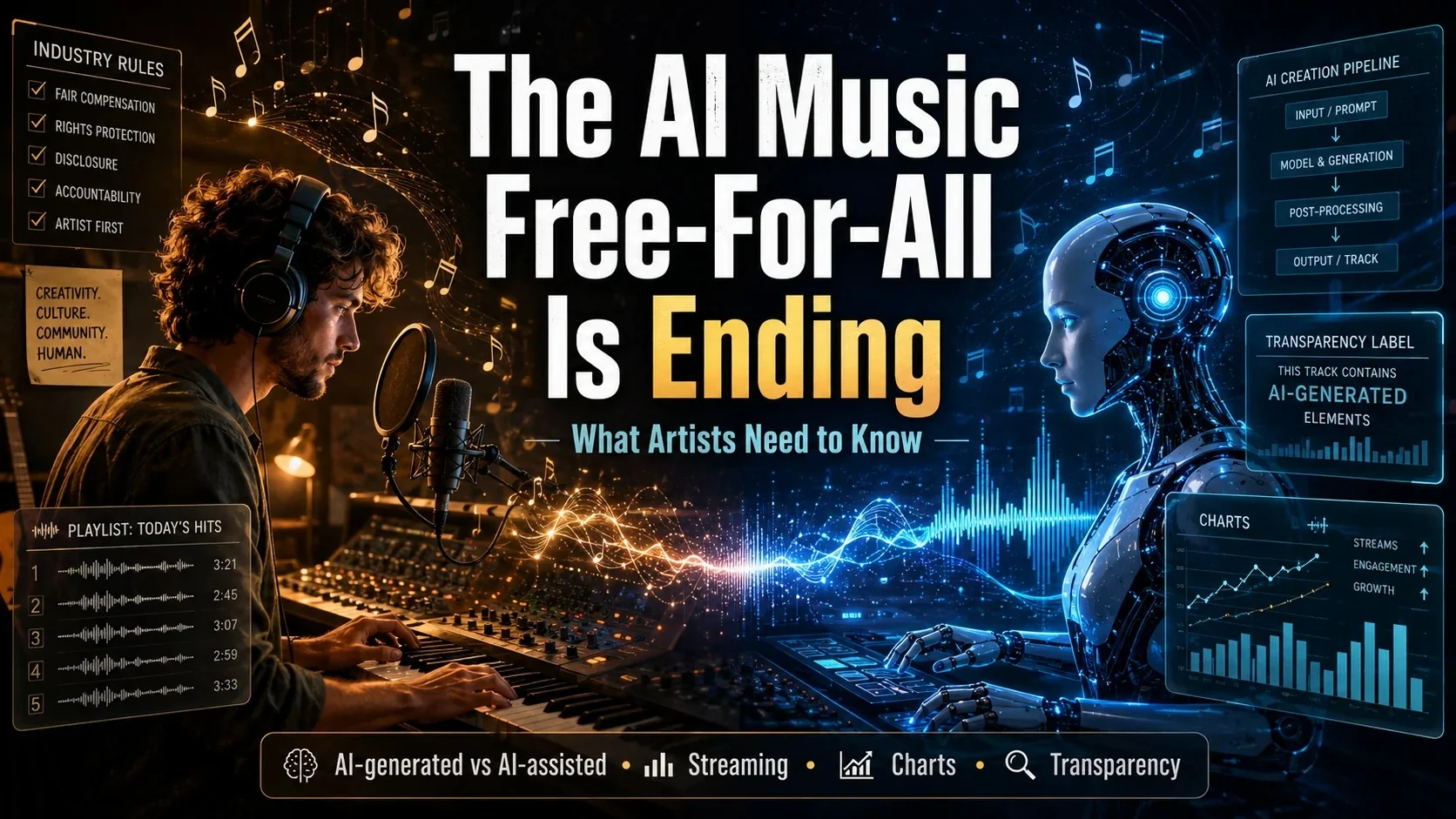
The AI Music Free-For-All Is Ending — Here’s What Artists Need to Knowtled draft
By Jalen Ross · 2026-08-28
AI music isn't going anywhere. Let's get that part out of the way first...
The AI Music Free-For-All Is Ending — Here’s What Artists Need to Know
By Jalen Cross | BTS Music Group
AI music isn't going anywhere. Let's get that part out of the way first.
But the days of creating an AI artist, uploading a hundred songs, hiding how the records were made, and expecting streaming platforms to treat everything exactly like a traditional artist release? Those days may be running out.
The music industry is starting to draw lines. Not between technology and creativity. Between AI-assisted creativity and completely AI-generated music. And if you're an independent artist, producer, songwriter, label owner, or somebody building an AI artist right now, you need to pay attention.
The Rules Are Starting to Change
For the past few years, AI music has basically been operating in the Wild West.
Generate the beat. Generate the singer. Generate the cover. Create a name. Upload it. Repeat.
There wasn't much separating a musician using AI as a production tool from somebody generating an entire catalog with a few prompts.
That's changing.
Australia's ARIA Charts recently announced that wholly AI-generated recordings will no longer qualify for its official charts beginning with the August 31, 2026 chart.
But here's the part people shouldn't overlook:
AI-assisted music can still qualify. That's important. Because the industry isn't simply saying, "AI is banned." It's asking a much more serious question:
Who actually created the record?
Using AI Doesn't Automatically Make You an AI Artist
This is where social media arguments usually lose the plot.
AI is already everywhere in music.
Producers use intelligent mastering software.
Engineers use AI-powered noise reduction.
Artists use vocal processing.
Songwriters brainstorm concepts with AI.
Creators generate artwork and music-video concepts.
None of that automatically means the human artist disappeared.
Technology has always been part of making music.
The real issue begins when the technology becomes the entire creative identity.
The face is generated.
The voice is generated.
The lyrics are generated.
The beat is generated.
The performance is generated.
The personality is generated.
At that point, we're dealing with something very different from a singer using AI to polish a vocal.
And now the industry is starting to recognize the difference too.
Spotify Just Made This Conversation Much Bigger
Spotify is moving toward more transparency around AI-created identities.
The platform announced plans for an AI Persona badge, designed to help listeners identify artist profiles built around an artificial identity rather than a traditional human performer.
That alone will get people talking.
But the algorithm conversation is even bigger.
Spotify has indicated that AI Personas will not automatically receive the same treatment inside editorial and algorithmic recommendation systems.
Think about what that could mean. Discover Weekly. Release Radar. Radio recommendations. Editorial playlists. Algorithmic discovery.
Independent musicians already fight every day for those opportunities.
If AI Personas have to rely less on automatic discovery, then whoever is behind these projects is going to have to become very good at something the music industry has always required:
Marketing. Because you can generate 500 songs.
You can't generate 500 loyal fans just because you typed a great prompt. That's the Part AI Creators Need to understand: music is only one piece of becoming an artist. The song gets somebody's attention. The story makes them care.
The personality keeps them watching.
The community keeps them coming back.
And that's where some AI projects are going to hit a wall.
There's a difference between generating content and building culture.
A computer can generate an incredible record.
But can the project make somebody buy a ticket?
Wear the shirt?
Join the mailing list?
Defend the artist in the comments?
Wait until midnight for the next release?
That's when things get interesting.
Because being technically impressive isn't the same thing as being culturally important.
Suno Is Growing Up Too
Even the companies making AI music tools are beginning to realize that the next stage can't operate without rules.
Suno has announced moves involving watermarking and fingerprinting AI-generated audio, along with stronger safeguards surrounding copyrighted material and impersonation.
Suno has also moved toward licensing relationships with companies such as BMG.
Pay attention to what that means.
AI music is slowly starting to look like the rest of the music industry.
Copyright.
Licensing.
Ownership.
Royalties.
Tracking.
Permissions.
Accountability.
The technology may be new.
The business questions aren't.
Somebody still wants to know who owns the record and who gets paid.
Transparency Is About to Become Currency
I think this is where the real shift is happening.
Eventually, asking whether a song "used AI" may become almost meaningless.
That's too broad.
The better question will be:
How was AI used?
Did AI master the record?
Help create an instrument?
Generate a background vocal?
Write the hook?
Perform the lead vocal?
Create everything?
Those aren't the same thing.
And artists who are transparent about their process may actually have an advantage.
Because listeners aren't necessarily afraid of technology.
People don't like feeling tricked.
Tell somebody they're listening to a virtual artist and they may think it's fascinating.
Convince them they're listening to a real singer and later reveal the entire identity was fabricated?
That's a different conversation.
Independent Artists Need Receipts
If you're creating music right now, start documenting your work.
Keep your lyrics.
Keep your session files.
Keep your stems.
Save your original vocals.
Document who wrote what.
Know which platforms were used.
Understand the commercial rights attached to the tools you're using.
If another artist's voice, likeness, composition, or copyrighted recording is involved, make sure you actually have permission.
This isn't the sexy part of making music.
But when money starts showing up, paperwork suddenly becomes very interesting.
And Stop Depending Completely on Algorithms
This lesson isn't just for AI artists.
It's for everybody.
Streaming platforms do not belong to you.
Instagram doesn't belong to you.
TikTok doesn't belong to you.
YouTube doesn't belong to you.
An algorithm update can change your reach tomorrow morning.
Build something you control.
A website.
An email list.
A fan community.
Direct relationships.
Merchandise customers.
People who search your name because they actually want to hear from you.
That's how you turn music into a brand instead of becoming another song floating through somebody else's recommendation engine.
So Who Is the Artist?
Here's the question I think the industry still hasn't answered.
A creator develops a fictional artist.
They write the concept.
They write the lyrics.
They choose the flow.
They direct the vocal.
They choose the beats.
They approve every song.
They develop the artwork.
They build the videos.
They handle the marketing.
They shape the entire personality.
But the singing voice is AI-generated.
Who made the music?
The AI?
The human?
Both?
Is that person a songwriter?
A producer?
A creative director?
A new type of artist we haven't properly named yet?
That's the conversation I'm interested in.
Because technology usually changes faster than the labels we use to describe it.
Jalen Cross' Take
I don't believe AI is destroying music.
I think lazy creativity is destroying lazy music.
And that existed long before anybody typed a prompt into an AI generator.
We've watched music panic over drum machines.
Sampling.
Auto-Tune.
Digital recording.
MP3s.
Streaming.
Every generation thinks the newest technology is going to kill the art form.
Then artists figure out how to use it.
AI won't be any different.
But there's one major difference this time:
AI can imitate the artist itself.
That's why transparency matters.
Use the technology.
Experiment.
Push boundaries.
Build characters.
Build worlds.
Create something people haven't heard before.
But understand that the industry is moving toward a future where audiences, platforms, and rights holders are going to expect creators to be clearer about what's human, what's assisted, and what's completely artificial.
The AI music free-for-all isn't necessarily ending because AI failed.
It's ending because AI music is becoming a real business.
And real businesses eventually get rules.
The artists who understand that early are going to have a major advantage over everybody who keeps pretending nothing is changing.
So here's the question:
Should fully AI-generated artists compete against human artists on the same charts and playlists?
Or should AI music have a lane of its own?
Sound off.
Jalen Cross
BTS Music Group — Join the Movement